Responsible Box Recycling, Zero Landfill
When a corrugated box reaches the end of its usable life, it still has value. Every fiber in that box can be recovered, pulped, and re-manufactured into new packaging. Boise Boxes ensures that 100% of end-of-life corrugated is recycled — never landfilled.
Schedule a Recycling Pickup
Tell us about the corrugated material you need recycled — volume, frequency, and location. We'll set up a pickup schedule that keeps your facility clean and your environmental reporting on track.
Our Recycling Process
From your loading dock to new corrugated board — here is exactly what happens to every box that enters our recycling stream.
Collection & Pickup
We collect end-of-life corrugated materials from your facility on a scheduled or on-demand basis. Our trucks pick up loose boxes, baled material, or dumpster-ready loads. You never need to transport anything yourself.
Sorting & Contamination Removal
At our facility, incoming material is sorted to remove contaminants: tape, staples, plastic inserts, wax coatings, and any non-corrugated materials. Clean corrugated fiber yields higher-quality recycled board, so meticulous sorting is critical.
Baling & Compression
Sorted corrugated is fed into our baler and compressed into standardized bales weighing approximately 1,000 to 1,200 pounds each. Baling reduces volume by over 90%, making transport to the processing mill far more efficient.
Mill Processing
Bales are transported to our partner recycling mills where the corrugated fiber is pulped — mixed with water and broken down into individual fibers. The pulp is cleaned, screened for contaminants, and re-formed into new linerboard and medium for corrugated board production.
New Board Manufacturing
The recycled linerboard and medium are laminated into new corrugated board at converting plants. This board is then cut, scored, and folded into new boxes — completing the recycling loop. A box made from recycled fiber performs comparably to one made from virgin material.
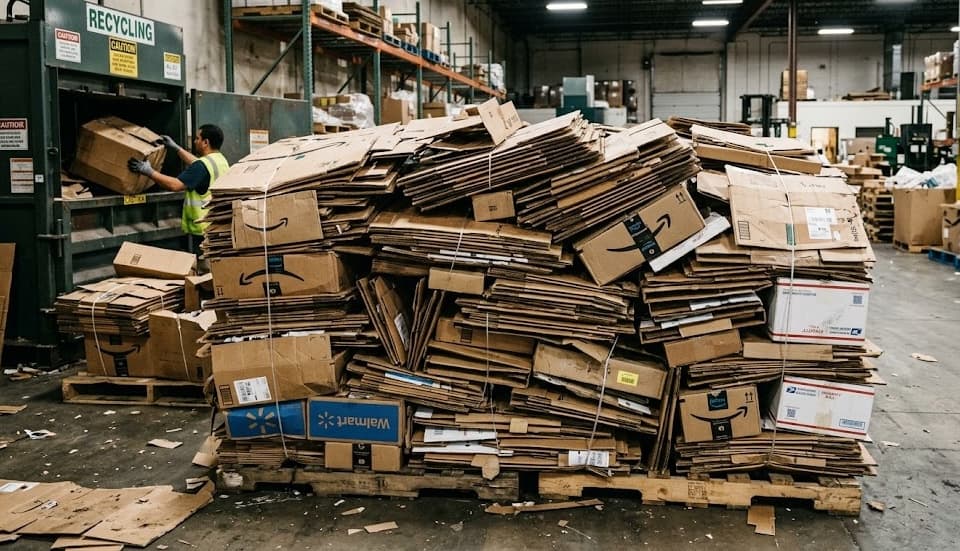
Flattened corrugated cardboard staged for baling and recycling at our facility
The Numbers Behind Corrugated Recycling
Corrugated packaging is one of the most successfully recycled materials on the planet. Here is the measurable environmental impact of choosing recycling over virgin production.
The corrugated industry has achieved a 94% recovery rate — the highest of any packaging material in the United States. When you recycle through Boise Boxes, your corrugated waste becomes part of this closed-loop system. We provide documented diversion data that you can use in sustainability reports, ESG disclosures, and green certification applications.
What We Accept for Recycling
Clean, dry corrugated fiber is the gold standard for recycling. Contaminated materials reduce the quality of recycled output and can cause entire bales to be rejected at the mill.
✓ Accepted Materials
- ✓Single-wall corrugated boxes
- ✓Double-wall and triple-wall corrugated boxes
- ✓Corrugated sheets and pads
- ✓Gaylord boxes and bulk containers
- ✓Corrugated partitions and dividers
- ✓Kraft paper and brown paper bags
- ✓Cardboard tubes and cores
✕ Cannot Be Recycled (Standard Process)
- ✕Wax-coated corrugated (produce boxes, seafood boxes)Wax contaminates the pulping process and must be processed at specialized facilities. We can arrange separate handling.
- ✕Wet, moldy, or water-damaged corrugatedMoisture weakens fiber bonds and promotes mold that contaminates entire bales. Wet material must be dried or disposed of separately.
- ✕Food-contaminated boxes (grease, oil, liquids)Organic residue introduces bacteria and oils that compromise recycled fiber quality. Pizza boxes with grease stains are a common example.
- ✕Corrugated with hazardous material residueChemical contamination poses safety risks during pulping and is prohibited at all domestic recycling mills.
- ✕Plastic-laminated or foil-lined corrugatedNon-fiber layers cannot be separated during standard pulping and contaminate the recycled output.
Partnering with Idaho's Recycling Infrastructure
Boise Boxes works directly with regional recycling mills and material recovery facilities (MRFs) throughout Idaho and the Pacific Northwest. Our partnerships ensure that the corrugated fiber we collect stays within the regional supply chain, minimizing transportation emissions and supporting local manufacturing jobs.
By consolidating corrugated waste from dozens of Treasure Valley businesses into efficient, high-quality bales, we achieve economies of scale that individual businesses cannot. This means better processing rates, more reliable pickup schedules, and higher-quality recycled output.
We also collaborate with the City of Boise's waste diversion programs and Ada County solid waste management to align our recycling operations with municipal sustainability goals. When the community sets a diversion target, Boise Boxes contributes measurable tonnage toward that goal.
Certified Processing
All partner mills meet EPA and state environmental compliance standards for wastewater discharge, air emissions, and solid waste handling.
Chain of Custody
We track every bale from collection to processing, providing full documentation for your sustainability reporting and audit requirements.
Regional Supply Chain
Recycled fiber stays in the Pacific Northwest, reducing the carbon footprint of transportation and supporting local corrugated manufacturing.
Diversion Reporting
Monthly or quarterly reports documenting tonnage recycled, CO2 offset, tree equivalents saved, and water consumption avoided.
Recycling vs. Landfill: The Real Cost
Sending corrugated to landfill is not just wasteful — it is increasingly expensive and environmentally damaging. Here is why recycling is the smarter choice.
| Factor | Landfill Disposal | Recycling with Boise Boxes |
|---|---|---|
| Direct Cost | Tipping fees of $45-75/ton (rising) | Free pickup, no processing fees |
| Greenhouse Gas | Corrugated decomposes into methane (28x CO2) | Zero emissions from decomposition |
| Resource Recovery | Fiber permanently lost to the supply chain | Fiber recovered and re-manufactured |
| Regulatory Risk | Increasing restrictions on organic waste in landfills | Full compliance with current and pending regulations |
| Brand Impact | No sustainability story to tell | Documented eco metrics for marketing and reporting |
Related Services
Recycling is the last step in our circular system. Most boxes can be reused first.
Ready to Recycle Responsibly?
Set up a recurring recycling pickup or schedule a one-time collection. Free pickup, no processing fees, and full documentation for your sustainability reporting.
Frequently Asked Questions
Answers to the questions customers ask most about this page.
What materials do you accept for box recycling?
We accept clean corrugated boxes, baled cardboard, and used gaylords; wet or contaminated loads may be rejected or downgraded.
Do you provide recycling pickups?
Yes, we schedule pickups across the Boise metro; regular routes are available for recurring volumes.
Can you supply weight tickets or certificates?
We can provide weight summaries and recycling attestations for your sustainability reporting.
How should boxes be prepared for recycling?
Flatten boxes, remove plastics when possible, and keep loads dry to preserve fiber quality and value.
Is there a cost for recycling pickup?
Pickup fees depend on volume, contamination, and location; high-quality loads may qualify for rebates.
Do you recycle waxed or coated boxes?
Waxed boxes are handled separately and may incur a fee; we will advise during scheduling.
What happens to the recycled cardboard?
Material is baled and sent to regional mills to become new containerboard and packaging.
Can you place a collection trailer on site?
For high-volume generators, we can stage trailers or bins to streamline accumulation.
Do you sort mixed loads?
We can sort, but pre-sorted corrugated reduces fees and improves rebate rates.
How quickly can you schedule first service?
Most first pickups are scheduled within 2–4 business days after confirming details.