Gaylord Boxes & Bulk Containers
Heavy-duty corrugated bulk containers for high-volume shipping, storage, and industrial applications. Available used and new in 2-wall, 3-wall, and 5-wall constructions with immediate availability from our Boise warehouse.
Get a Quote on Gaylord Boxes
Tell us the size, wall thickness, and quantity you need. We'll send a detailed quote with pricing for both used and new options within one business day.
What Are Gaylord Boxes?
A gaylord box — also known as a bulk bin, pallet box, or tote box — is a large, heavy-duty corrugated container designed to sit on a standard pallet and hold bulk quantities of products for shipping, storage, or manufacturing processes. The name comes from the Gaylord Container Corporation, which pioneered the design in the mid-20th century.
Unlike standard corrugated shipping boxes, gaylords are engineered for significantly higher weight capacities. Their multi-wall construction creates a rigid structure capable of holding anywhere from 500 to 2,500+ pounds depending on the wall configuration. This makes them the preferred container for industries that need to move large volumes of material efficiently.
Gaylords are designed to fit standard 48" x 40" pallets, the most common pallet size in North American logistics. This means they integrate seamlessly with existing warehouse racking, forklifts, pallet jacks, and shipping infrastructure without any modification to your operations.
Cost-Effective Bulk Shipping
One gaylord replaces dozens of smaller boxes, reducing packaging material costs, labor time, and freight complexity.
Reusable & Recyclable
A well-maintained gaylord can be reused 3-5 times. When it reaches end of life, it is 100% recyclable.
Replaces Wood & Plastic
Multi-wall gaylords offer comparable strength to wooden crates at a fraction of the weight and cost, without fumigation requirements for international shipping.
Foldable for Storage
When not in use, gaylords collapse flat for efficient storage — a major advantage over rigid wooden crates and plastic bins.
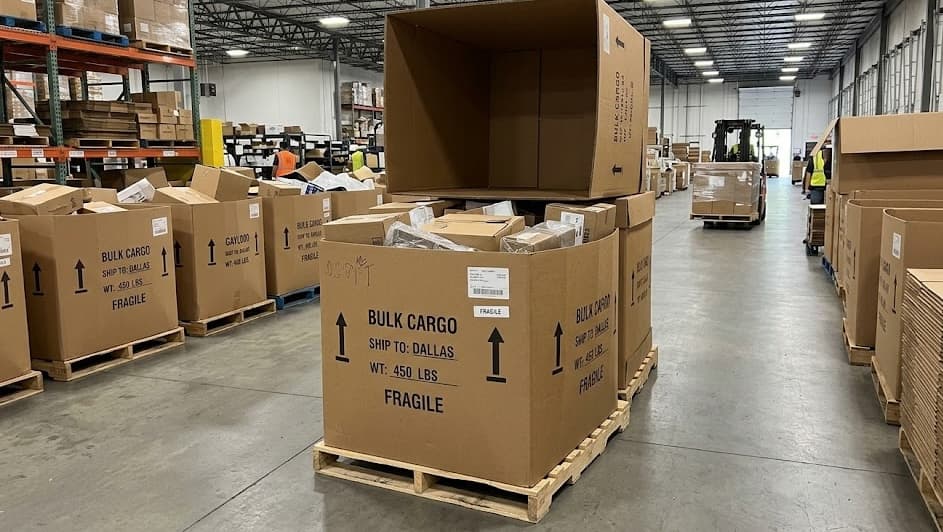
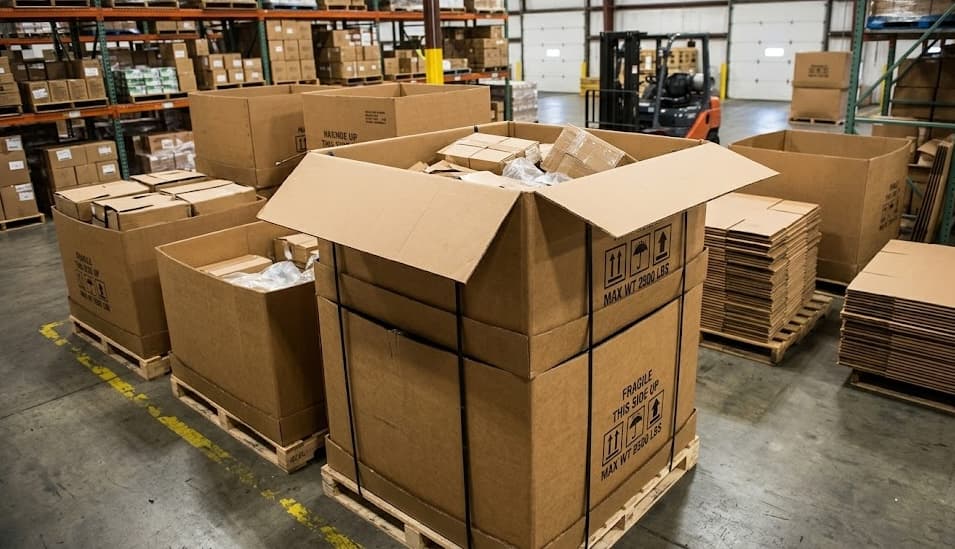
Gaylord Boxes in Our Warehouse
The History of Gaylord Boxes
The gaylord box traces its origins to the Gaylord Container Corporation, founded in St. Louis, Missouri, in the 1930s. The company specialized in corrugated containerboard products and became one of the largest producers of heavy-duty corrugated packaging in North America.
In the 1950s and 1960s, as American manufacturing expanded rapidly, there was a growing need for bulk shipping containers that could handle heavy loads without the cost and weight of wooden crates. Gaylord Container Corporation responded by developing oversized, multi-wall corrugated boxes specifically designed to fit standard pallets and integrate with emerging forklift-based warehouse operations.
The design was revolutionary for its time. By laminating multiple layers of corrugated medium between linerboard sheets, the company created a container that was strong enough to hold over 1,000 pounds yet weighed a fraction of an equivalent wooden crate. The boxes could be manufactured flat, shipped efficiently, and erected on-site — a logistics advantage that wooden crates could not match.
Over time, the brand name "Gaylord" became genericized — much like "Kleenex" for tissues or "Xerox" for copies. Today, "gaylord box" is the standard industry term for any large, pallet-sized corrugated bulk container, regardless of the manufacturer. The Gaylord Container Corporation itself went through several mergers and acquisitions, eventually becoming part of Temple-Inland in 2002 and later International Paper, but the name lives on throughout the packaging industry.
In modern logistics, gaylord boxes remain indispensable. They are the backbone of bulk material handling in agriculture, recycling, automotive manufacturing, distribution, and dozens of other industries. The basic design principles have remained remarkably consistent over seven decades, a testament to the elegance of the original engineering.
How Gaylord Boxes Are Made
Understanding the manufacturing process helps you appreciate the engineering behind every gaylord and make more informed purchasing decisions.
Linerboard Production
Kraft linerboard is produced from wood pulp (for new boxes) or recycled fiber (for recycled content boxes). The pulp is formed into flat sheets on a paper machine, dried, and wound into large rolls. Linerboard weight is measured in pounds per 1,000 sq ft, typically ranging from 26 lb to 90 lb for gaylord applications.
Corrugating Medium
The corrugating medium — also called the fluting — is produced from a lighter-weight paper. On the corrugator machine, this paper is heated and pressed between corrugating rolls to form the characteristic wave pattern. The flute height and frequency are precisely controlled to create the specified profile (B, C, or BC combination).
Lamination
On the corrugator line, the fluted medium is glued to the linerboard sheets using starch-based adhesive. For multi-wall construction, additional layers are laminated together. A 3-wall gaylord requires seven individual sheets bonded in sequence: liner, flute, liner, flute, liner, flute, liner.
Scoring & Slotting
The laminated board is cut to size and scored (creased) along fold lines. Slots are cut for flap separation. For gaylord boxes, precision scoring is critical — a poorly scored crease creates a weak point that can cause wall failure under load.
Folding & Joining
The scored blank is folded and the manufacturer joint is formed — typically a glued, taped, or stitched seam along one vertical edge. For gaylords, stitched joints (wire stitching) provide the strongest seam, essential for heavy loads.
Quality Testing
Finished gaylords undergo ECT (Edge Crush Test), Mullen burst testing, and dimensional verification. Samples from each production run are tested to ensure they meet the specified strength ratings. Boxes that fail testing are recycled back into the production stream.
Wall Types & Construction
The number of corrugated walls determines a gaylord's strength, weight capacity, and cost. Choosing the right wall type prevents both over-engineering (wasted money) and under-engineering (damaged goods).
Two layers of fluted medium sandwiched between three liners. The workhorse of mid-range bulk packaging. Suitable for products up to 80 lbs per cubic foot density. Commonly used for lightweight bulk goods like plastic parts, textiles, and consumer products.
Best for: Lightweight to medium goods, internal transfers, short-distance shipping
Three layers of corrugated medium between four liners, creating a rigid, high-strength container. Often considered a substitute for wooden crates in applications where weight savings and recyclability are priorities. Used extensively in automotive, industrial manufacturing, and agriculture.
Best for: Heavy industrial parts, agricultural products, long-distance freight
Five layers of corrugated medium creating the strongest corrugated container available. Engineered for extreme weight loads and rough handling environments. 5-wall gaylords can replace wooden crates and plastic bins in many applications while offering significant cost and weight advantages.
Best for: Heavy machinery components, metal parts, extreme-weight applications
Weight Capacity by Wall Type & Size
Maximum recommended weight loads vary by both wall type and box dimensions. Larger boxes with the same wall type have slightly lower capacity because the unsupported span of each wall panel is longer.
| Wall Type | 48x40x36 | 48x40x48 | 48x48x48 | 58x42x45 |
|---|---|---|---|---|
| 2-Wall | 900 lbs | 800 lbs | N/A | N/A |
| 3-Wall | 1,300 lbs | 1,200 lbs | 1,500 lbs | 1,800 lbs |
| 5-Wall | 2,000 lbs | 1,800 lbs | 2,200 lbs | 2,500 lbs |
Weight capacities are for new boxes. Used gaylords retain 85-100% of rated capacity depending on condition grade. See our grading system.
Stacking Guidelines
Proper stacking is critical for warehouse safety and product protection. Exceeding stacking limits causes bottom-box compression failure, product damage, and safety hazards.
Max: 2 High
- --Both boxes on pallets
- --Bottom box at no more than 75% of rated capacity
- --Level, dry floor surface
- --No dynamic loads (no forklift traffic vibration)
Do not stack 2-wall gaylords more than 2 high under any circumstances. The lower ECT rating cannot safely support additional compression.
Max: 3 High
- --All boxes on pallets
- --Bottom box at no more than 70% of rated capacity
- --Level, dry floor surface
- --Interlocked stacking pattern preferred
For 3-high stacking, reduce bottom box load by 30% to account for compression from upper boxes. Use load-bearing pallet caps between levels.
Max: 4 High
- --All boxes on pallets
- --Bottom box at no more than 65% of rated capacity
- --Racking or level floor required
- --Regular stack inspections recommended
Even with 5-wall strength, 4-high stacking requires careful load management. Total stack height with pallets can reach 16+ feet — verify ceiling clearance.
Standard Gaylord Sizes
We stock the most common gaylord sizes and can source specialty dimensions from our regional network. All dimensions listed as Length x Width x Height in inches.
| Size (L x W x H) | Wall Options | Common Application | Weight Capacity | Volume |
|---|---|---|---|---|
| 48 x 40 x 36 | 2-Wall / 3-Wall / 5-Wall | Standard pallet-fit, most common bulk container | Up to 1,000 lbs | 40 cu ft |
| 48 x 40 x 48 | 2-Wall / 3-Wall / 5-Wall | Tall goods, lightweight bulk materials | Up to 1,200 lbs | 53 cu ft |
| 48 x 40 x 24 | 2-Wall / 3-Wall | Half-height, heavy products, engine parts | Up to 800 lbs | 27 cu ft |
| 48 x 48 x 36 | 3-Wall / 5-Wall | Square footprint for wider loads | Up to 1,500 lbs | 48 cu ft |
| 48 x 48 x 48 | 3-Wall / 5-Wall | Maximum volume bulk container | Up to 1,500 lbs | 64 cu ft |
| 58 x 42 x 45 | 3-Wall / 5-Wall | Oversized loads, automotive parts | Up to 2,000 lbs | 64 cu ft |
| 40 x 30 x 30 | 2-Wall / 3-Wall | Smaller bulk items, retail distribution | Up to 600 lbs | 21 cu ft |
| Custom | Any | Made-to-order dimensions for specific needs | Varies | Varies |
Don't see your size? Contact us for custom gaylord dimensions →
Storage Best Practices
Proper storage extends the usable life of your gaylord boxes and maintains their structural integrity between uses.
Store Flat When Empty
Collapse gaylords flat and store vertically (on edge) against a wall or in a rack. This prevents floor moisture contact and saves space. A 48x40x36 gaylord collapses to roughly 1" thick, allowing you to store 40+ boxes in a 4-foot deep rack section.
Keep Dry & Indoors
Corrugated board absorbs moisture aggressively. Even moderate humidity (above 65% RH) can reduce compression strength by 30%. Store gaylords in a dry, climate-controlled warehouse. If outdoor storage is unavoidable, use waterproof tarps or poly covers.
Avoid Direct Sunlight
Prolonged UV exposure degrades the lignin in corrugated fibers, causing brittleness and discoloration. Store boxes away from skylights, open doors, and south-facing windows in your warehouse.
Rotate Stock (FIFO)
Use first-in, first-out rotation for your gaylord inventory. Corrugated fibers degrade gradually over time even in ideal storage conditions. Using older stock first ensures maximum structural performance.
Inspect Before Each Use
Before erecting a stored gaylord for use, inspect all four walls and the bottom for moisture damage, pest activity, compression creases, and adhesive failure. A quick 30-second inspection prevents costly in-transit failures.
Elevate Off Concrete Floors
Concrete floors wick moisture through capillary action. Place stored gaylords on pallets, dunnage, or foam pads to create an air gap between the corrugated board and the floor surface.
Flap Configurations
The flap style affects how you load, close, and stack your gaylord boxes. Choose the configuration that fits your workflow.
Full Top & Bottom Flaps
Standard configuration with four flaps on top and bottom. Provides maximum closure and stackability. Most common for shipping and storage where full enclosure is required.
Full Bottom / No Top (Open Top)
Bottom flaps for structural base, open top for easy loading. Widely used on production lines and in agricultural packing operations where boxes are filled from above and covered with a separate lid.
Half Flaps
Shortened flaps that do not fully close the box. Reduces material cost and weight while still providing partial containment. Common in applications where contents are stacked and do not need full enclosure.
No Flaps (Sleeve/Tube)
A rectangular sleeve with no top or bottom flaps. Used as a wrap-around container on pallets or combined with separate top and bottom trays for modular packaging systems.
Food-Grade vs. Industrial Gaylords
Not all gaylords are created equal. If your application involves food contact, pharmaceutical products, or clean-room environments, you need to understand the distinction between food-grade and industrial-grade containers.
| Attribute | Food-Grade Gaylords | Industrial Gaylords |
|---|---|---|
| Material | Virgin kraft linerboard, food-safe adhesives | Virgin or recycled linerboard, standard adhesives |
| FDA Compliance | Yes — meets 21 CFR 176.170 | Not required |
| Prior Use | New only (no prior use for direct food contact) | New or used |
| Ink & Printing | Food-safe inks only, limited printing | Standard inks, full-color printing available |
| Interior Liners | Food-grade poly liners required for most applications | Optional — standard poly or kraft liners |
| Typical Industries | Produce, bakery, meat processing, pet food | Automotive, recycling, manufacturing, distribution |
| Price Premium | 15-30% more than industrial | Standard pricing |
Need food-grade gaylords? Contact us for availability and pricing. We stock new food-grade gaylords in standard sizes.
Pallet Compatibility Guide
Matching your gaylord to the right pallet is essential for stability, safety, and efficient handling. Overhang creates forklift hazards, while undersized gaylords waste pallet deck space.
| Pallet Size | Compatible Gaylords | Overhang | Notes |
|---|---|---|---|
| 48" x 40" (GMA Standard) | 48x40x36, 48x40x48, 48x40x24 | None | Most common pallet in North America. Perfect fit for standard gaylords. |
| 48" x 48" | 48x48x36, 48x48x48 | None | Square pallet used in drum and barrel industries. Allows wider loads. |
| 42" x 42" | 40x30x30 (with overhang) | 1-2" per side | Used in telecom and paint industries. Requires careful centering. |
| 60" x 48" | 58x42x45 | None | Oversized pallet for automotive and industrial applications. |
| 48" x 40" (Plastic) | All standard sizes | Varies | Reusable plastic pallets for closed-loop supply chains. FDA compliant. |
We stock wood and plastic pallets in all standard sizes to pair with your gaylord order.
Cost Savings Analysis
Used gaylords deliver dramatic savings over both new gaylords and alternative containers like wooden crates. Here is a representative cost comparison with estimated annual savings for a business using 100 units per year.
| Container Type | New Price | Used Price | Savings % | Annual Savings (100/yr) |
|---|---|---|---|---|
| New 3-Wall Gaylord (48x40x36) | $45-$55 | $15-$25 | 50-60% | $2,000-$3,000 |
| New 5-Wall Gaylord (48x40x48) | $60-$75 | $25-$35 | 45-55% | $3,500-$4,000 |
| New 2-Wall Gaylord (48x40x36) | $25-$35 | $8-$15 | 55-65% | $1,700-$2,000 |
| Wooden Crate (48x40x36) | $80-$120 | $15-$25 (gaylord) | 75-80% | $6,500-$9,500 |
Additional Cost Benefits of Used Gaylords
- --No minimum order quantities — buy as few as 1 unit vs. 50-100 unit MOQs for new boxes
- --No setup fees or tooling charges that new box orders often require
- --Same-day availability eliminates the 1-3 week lead time of new box orders
- --Sell back qualifying boxes through our buyback program to recover 25-50% of your purchase cost
- --Reduced disposal costs — you are reusing, not creating waste that requires hauling fees
New vs. Used Gaylords
We carry both new and used gaylord boxes. Here's how to decide which is right for your application.
| Consideration | New Gaylords | Used Gaylords |
|---|---|---|
| Price | $25-$75+ per unit | $8-$35 per unit |
| Strength | Full rated capacity | 85-100% of rated capacity |
| Appearance | Clean, branded if needed | May show prior use marks |
| Best For | Customer-facing, export, food-grade | Internal, storage, B2B, agriculture |
| Lead Time | 3-10 business days | Same-day to 2 days |
| Environmental Impact | New fiber production required | Zero new resources used |
| Minimum Order | Typically 50-100 units | 1 unit — no minimums |
Handling Equipment Requirements
Gaylord boxes are designed to be handled with standard warehouse equipment. Here is what you need to safely receive, move, and store gaylords in your facility.
Forklift (Standard)
A standard counterbalance forklift with 48" forks handles all standard gaylord sizes. Minimum 3,000 lb capacity for 2-wall boxes, 5,000 lb capacity for loaded 5-wall gaylords. Ensure forks are spaced to match the pallet stringer spacing.
Pallet Jack
A manual or electric pallet jack can move gaylords short distances on level floors. Adequate for warehouse staging and dock loading. Not suitable for lifting loaded gaylords to elevated racking.
Dock Leveler
A dock leveler or ramp is needed to bridge the gap between your warehouse floor and the delivery truck bed. Most gaylord deliveries arrive on 53-foot trailers with bed heights of 48-52 inches.
Scale (Floor Scale)
A floor scale rated for pallet weights (up to 5,000 lbs) allows you to verify load weights before stacking and shipping. Essential for compliance with DOT weight limits and carrier requirements.
Stretch Wrapper
A turntable or rotary arm stretch wrapper secures gaylords to pallets for transport. Machine wrapping provides more consistent tension than hand wrapping, reducing the risk of load shift during transit.
Pallet Racking
Standard selective pallet racking accommodates gaylords with a minimum 48" clear beam span. Ensure beam capacity meets your maximum loaded gaylord weight plus pallet weight. Verify upright clearance for 48" tall gaylords.
Safety Guidelines
Gaylord boxes handle heavy loads in active warehouse environments. Following these safety guidelines protects your personnel, your products, and your equipment.
Weight Limits
Never exceed the rated weight capacity for the wall type. Overloading causes structural failure, collapse during stacking, and potential injury to warehouse personnel. Always account for the weight of the gaylord itself (15-65 lbs) when calculating total pallet weight.
Stacking Height
Follow stacking guidelines: 2 high for 2-wall, 3 high for 3-wall, 4 high for 5-wall (when loaded). Exceeding stacking limits creates crush hazards. Always verify bottom box condition before adding stacking layers.
Forklift Handling
Always lift gaylords on pallets using a forklift or pallet jack. Never lift a loaded gaylord by its flaps or walls. Center the forks under the pallet and tilt back slightly before moving. Ensure clear sightlines when transporting.
Moisture Exposure
Corrugated board loses up to 60% of its compression strength when wet. Store gaylords indoors in dry conditions. For outdoor or cold-storage use, consider poly liners or wax-coated options.
Sharp Contents
Metal parts, glass, and other sharp items can puncture gaylord walls from the inside. Use interior liners, edge protectors, or foam padding to prevent puncture damage. Inspect walls after each use for internal damage.
Inspection Before Reuse
Before reusing a gaylord, inspect all four walls, bottom flaps, and corners for tears, punctures, moisture damage, and compression creases. A compromised wall can cause sudden failure under load. Discard or recycle damaged gaylords.
Common Mistakes to Avoid
These are the most frequent mistakes we see businesses make with gaylord boxes. Each one leads to preventable product damage, safety risks, or unnecessary costs.
Choosing the wrong wall type
2-wall gaylords loaded with heavy industrial parts collapse during shipping. Result: damaged goods, freight claims, and safety hazards.
Match wall type to product weight density. When in doubt, go one wall type up.
Ignoring moisture damage
A gaylord with water stains or soft spots can lose 60% of its stacking strength. Result: box collapse under normal stacking loads.
Inspect for moisture damage before every use. Store indoors. Use poly liners for wet environments.
Overloading beyond rated capacity
Bottom blowout or wall buckling during handling. Result: product loss, potential injury, equipment damage.
Know the rated capacity for your wall type and size. Weigh loads when in doubt.
Stacking too high
Bottom boxes crush under excessive compression. Result: product damage throughout the stack, unstable pallets.
Follow stacking guidelines (2-high for 2-wall, 3-high for 3-wall, 4-high for 5-wall).
Using wrong pallet size
Gaylord overhangs pallet edges, creating forklift hazards and reducing stability. Result: boxes fall during transport.
Match gaylord dimensions to pallet dimensions. Use GMA standard 48x40 pallets for standard gaylords.
Skipping interior protection
Sharp, heavy, or loose items shift and puncture walls from inside. Result: wall failure during transit.
Use poly liners, edge protectors, and interior padding for sharp or heavy contents.
Industries That Depend on Gaylords
Gaylord boxes are essential infrastructure for industries that move high volumes of material efficiently and cost-effectively.
Agriculture & Produce
Idaho potato farms, onion packers, fruit orchards, and grain handlers use gaylords for field-to-warehouse transport. Used gaylords are especially popular since soil contact is unavoidable.
Manufacturing
Assembly plants and production facilities use gaylords as work-in-progress containers, scrap collection bins, and finished goods shipping containers for bulk components.
Recycling & Waste Management
Recycling facilities, MRFs, and waste processors use gaylords to sort and stage recyclable materials including plastics, metals, paper, and e-waste.
Distribution & 3PL
Third-party logistics providers and distribution centers use gaylords for consolidating orders, cross-docking, and managing high-SKU inventory.
Automotive
Auto manufacturers and parts suppliers use 5-wall gaylords to ship heavy components like engines, transmissions, brake assemblies, and body panels safely.
Retail & E-Commerce
Fulfillment centers use gaylords as pick bins, return collection containers, and bulk inbound receiving containers from vendors.
Glossary of Terms
The corrugated packaging industry uses specialized terminology. Here is a quick reference guide to the most important terms you will encounter when ordering gaylord boxes.
Gaylord Box
A large corrugated bulk container designed to sit on a pallet, named after the Gaylord Container Corporation that popularized the design.
ECT (Edge Crush Test)
A measurement of the force (in lbs/linear inch) required to crush a corrugated board sample on edge. Predicts stacking strength.
Mullen Burst Test
A measurement of the pressure (in psi) required to puncture the face of corrugated board. Indicates resistance to puncture and burst.
Flute
The wavy, corrugated layer between flat linerboard sheets. Creates the arch structures that give corrugated board its strength.
Linerboard
The flat outer and inner facing sheets of corrugated board. Provides the printing surface and protects the fluted medium.
RSC (Regular Slotted Container)
The most common box style. All flaps are the same length, and the outer flaps meet at the center when folded.
GMA Pallet
Grocery Manufacturers Association standard pallet measuring 48" x 40". The most common pallet size in North America.
Bulk Bin
Another name for a gaylord box. Also called a pallet box, tote box, or bulk container.
Compression Strength
The total load a box can withstand before collapsing. Determined by ECT rating, box dimensions, and board caliper.
Caliper
The thickness of corrugated board, measured in thousandths of an inch. Higher caliper means thicker, stronger board.
Complete Your Bulk Packaging
Pair your gaylords with these complementary products for a complete packaging solution.
Ready to Order Gaylord Boxes?
Whether you need 10 or 10,000, we have competitive pricing on both used and new gaylords with fast delivery throughout the Boise metro area.