Corrugated Shipping Boxes
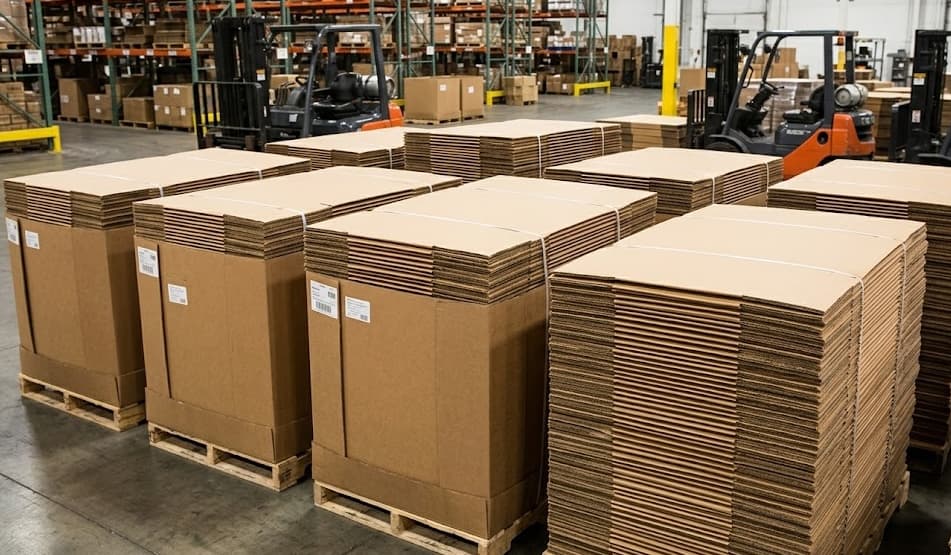
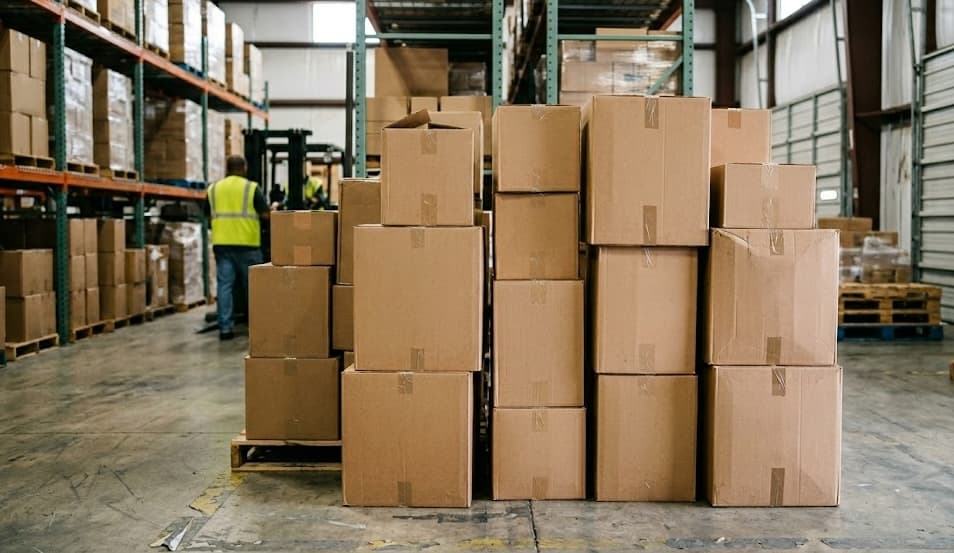
Single-wall, double-wall, and triple-wall corrugated boxes in every standard size and flute type. New and used inventory with same-day availability from our Boise, Idaho facility at 805 S 17th St.
Get a Quote on Corrugated Boxes
Specify your dimensions, wall type, quantity, and intended use. We'll recommend the right box and send pricing within one business day.
Understanding Corrugated Board
Corrugated board consists of a fluted (wavy) medium sandwiched between flat linerboard sheets. The fluted medium creates arch-like structures that provide remarkable strength-to-weight ratio, cushioning, and insulation. The number of fluted layers determines the "wall" classification and overall performance characteristics of the box.
Linerboard
The flat outer and inner sheets that form the faces of corrugated board. Made from kraft (virgin wood pulp) or recycled fiber. Liner weight ranges from 26 lb to 90 lb per 1,000 sq ft and directly affects puncture resistance, print quality, and moisture performance.
Corrugating Medium
The wavy inner layer that gives corrugated board its name and its strength. The medium is formed into a precise wave pattern (flute) that creates thousands of tiny arch columns per square foot, distributing loads efficiently across the board surface.
Adhesive
Starch-based adhesive bonds the fluted medium to the linerboard faces. The adhesive must resist delamination under humidity, temperature changes, and mechanical stress. Most modern adhesives are water-based and fully recyclable.
Our Corrugated Inventory
Wall Types
Selecting the correct wall type is the most important decision in corrugated packaging. Under-specifying risks product damage; over-specifying wastes money.
The most common corrugated construction, used in the vast majority of shipping boxes worldwide. A single fluted medium is glued between two flat linerboard faces. Single-wall boxes are lightweight, cost-effective, and suitable for products weighing up to about 65 pounds. They work well for standard e-commerce shipments, retail packaging, and light industrial applications.
Best for: E-commerce, retail, light products, moving boxes
Two layers of fluted medium separated by an inner liner create a significantly stronger and more rigid box. Double-wall corrugated provides superior stacking strength, puncture resistance, and cushioning. Ideal for heavier products, fragile items, and shipments that will be stacked on pallets during transit. Often used when single-wall is not strong enough but triple-wall would be over-engineered.
Best for: Heavy products, fragile goods, pallet-stacked shipments
The strongest corrugated construction available in standard box formats. Three layers of fluted medium create a board so rigid it is often used as a replacement for wooden crates and pallets. Triple-wall boxes are engineered for extreme weight, rough handling, and long-distance freight. They can support loads of 300+ pounds and withstand the compression forces of deep pallet stacking.
Best for: Industrial parts, machinery, export shipping, crate replacement
Complete Flute Science
The flute profile is the engineering heart of corrugated board. Each profile offers a different balance of cushioning, crush resistance, printing quality, and material efficiency. Understanding flute science helps you specify the optimal board for your application.
| Flute | Height | Metric | Flutes/ft | Flat Crush | Cushioning | Stacking | Print Quality |
|---|---|---|---|---|---|---|---|
| A-Flute | 3/16" | 4.8 mm | 33/ft | 35-40 psi | Excellent | Good | Fair |
| B-Flute | 1/8" | 3.2 mm | 47/ft | 45-55 psi | Good | Excellent | Good |
| C-Flute | 5/32" | 4.0 mm | 39/ft | 38-45 psi | Very Good | Very Good | Good |
| E-Flute | 1/16" | 1.6 mm | 90/ft | 50-60 psi | Fair | Good | Excellent |
| F-Flute | 1/32" | 0.8 mm | 125/ft | 55-65 psi | Fair | Fair | Excellent |
| BC-Flute (Double-Wall) | 1/4" | 6.5 mm | Combo | 60-80 psi | Very Good | Excellent | Good |
3/16" tall, 33/ft flutes/ft
Tallest standard flute. Maximum cushioning for fragile products. Good stacking strength but coarser surface for printing. A-flute was the original corrugated profile, dating back to the early 1900s. Its tall arches provide the best shock absorption of any standard flute, making it ideal for glass, ceramics, and other fragile items.
Best applications: Fragile products, glass bottles, ceramics, electronics with static-sensitive components
1/8" tall, 47/ft flutes/ft
Shorter, denser flute. Excellent crush resistance and flat surface for printing. Popular for die-cut boxes and point-of-sale displays. B-flute has more flutes per foot than any standard profile except E and F, creating a denser, more rigid board that resists flat crushing exceptionally well.
Best applications: Die-cut retail displays, canned goods, bottled beverages, heavy canned foods
5/32" tall, 39/ft flutes/ft
The most widely used flute size — a balanced compromise between A and B. Good cushioning, good stacking strength, good printability. C-flute accounts for approximately 80% of all corrugated boxes produced. If a box specification does not specify a flute type, it is almost certainly C-flute.
Best applications: General shipping, e-commerce, food products, household goods, office supplies
1/16" tall, 90/ft flutes/ft
Thin, dense micro-flute. Excellent printing surface and fold lines. Used for retail packaging, mailer boxes, and premium unboxing experiences. E-flute is the fastest-growing corrugated profile, driven by the rise of e-commerce and subscription box brands that demand high-quality printed packaging.
Best applications: Mailer boxes, subscription boxes, cosmetics, premium retail packaging, pizza boxes
1/32" tall, 125/ft flutes/ft
The thinnest standard corrugated profile. F-flute is so thin it approaches the characteristics of solid fiber board while retaining the structural advantages of corrugation. Creates an exceptionally smooth surface that rivals solid board for print quality. Increasingly used in food service and retail packaging where shelf presence matters.
Best applications: Fast food containers, jewelry boxes, shoe boxes, cosmetic packaging, small electronics
1/4" tall, Combo flutes/ft
Double-wall combination of B and C flutes. The most common double-wall configuration, offering excellent all-around performance for heavy-duty applications. B-flute on the outside provides a good printing surface and flat crush resistance, while C-flute on the inside provides cushioning and column strength.
Best applications: Heavy industrial parts, export shipping, multi-item pallet loads, automotive components
ECT vs. Mullen Burst Test: Complete Comparison
Two competing standards measure corrugated strength. Understanding when to use each helps you specify the right box and avoid over-engineering or under-specifying.
Stacking Strength Standard
The Edge Crush Test (ECT) measures the force required to crush a corrugated board sample standing on its edge. Expressed in pounds per linear inch (lbs/in), ECT directly predicts a box's ability to resist compression forces during pallet stacking. ECT has become the dominant standard since the 1990s because it better predicts real-world stacking performance.
When to choose ECT: Use ECT-rated boxes when stacking strength is the primary concern. This includes pallet-stacked warehouse storage, multi-tier truck loads, and any application where boxes must support weight from above. ECT testing typically uses less material than equivalent Mullen-rated boxes, reducing cost by 10-15%.
Puncture Resistance Standard
The Mullen Burst Test measures the pressure required to puncture or rupture the face of corrugated board. Expressed in pounds per square inch (psi), the burst test indicates a box's ability to contain heavy, dense products without wall failure. Mullen was the original corrugated strength standard and remains relevant for specific applications.
When to choose Mullen: Use Mullen-rated boxes when the contents are dense, sharp, or heavy relative to box size. This includes metal parts, hardware, tools, and products that concentrate pressure on small areas of the box wall. Mullen testing is also still required by some legacy carrier specifications.
| Attribute | ECT (Edge Crush Test) | Mullen (Burst Test) |
|---|---|---|
| Measures | Compression / stacking strength | Puncture / burst resistance |
| Units | lbs per linear inch (lbs/in) | Pounds per square inch (psi) |
| Best Predicts | Warehouse stacking performance | Resistance to internal puncture |
| Material Usage | 10-15% less board weight | Heavier board for equivalent rating |
| Industry Trend | Growing (preferred standard) | Declining (legacy standard) |
| Most Common Rating | 32 ECT (single-wall) | 200# Test (single-wall) |
Box Manufacturer Certificate (BMC)
Every new corrugated box bears a round stamp on the bottom flap called the Box Manufacturer Certificate (BMC), formerly known as the Box Maker's Certificate. This stamp certifies the box meets the strength standards required by common carriers (UPS, FedEx, USPS, freight lines). Understanding how to read the BMC helps you verify box specifications.
Box Manufacturer
The name and address of the box manufacturer. Certifies that the box was produced to ASTM and carrier standards.
Size Limit
Maximum combined length + width + height (L+W+H) in inches. Boxes exceeding this limit are subject to carrier surcharges.
Gross Weight Limit
Maximum weight the box is rated to contain, in pounds. Exceeding this voids the manufacturer certification.
Burst Test (Mullen)
Minimum bursting strength in psi. Only present on Mullen-tested boxes (not ECT-tested).
ECT Value
Edge Crush Test rating in lbs/linear inch. Only present on ECT-rated boxes. Cannot appear simultaneously with Mullen rating.
Board Construction
Identifies wall type (single, double, triple) and board grade (e.g., 200# single wall or 48 ECT single wall).
City & State
Location where the box was manufactured. Used for quality traceability and carrier compliance verification.
BMC on Used Boxes
Used boxes may have a partially visible or faded BMC stamp. While the certification technically applies only to the original manufacturer's guarantee, the stamp is still useful for identifying the box's original specifications (ECT rating, weight limit, and wall type). At Boise Boxes, we independently test and grade every used box regardless of BMC stamp condition, so you can trust our ratings even when the original stamp is no longer legible. View our grading system.
Moisture Resistance Ratings
Moisture is the primary enemy of corrugated packaging. Standard corrugated board can lose up to 60% of its compression strength at high humidity levels. Understanding moisture resistance options is critical for applications involving refrigeration, produce, seafood, or outdoor storage.
| Treatment | Humidity Level | Strength Retention | Application | Cost Premium |
|---|---|---|---|---|
| Standard Kraft | 50% RH | 100% | Indoor, climate-controlled environments | Baseline |
| Standard Kraft | 80% RH | 60-70% | Humid warehouses (not recommended) | Baseline |
| Standard Kraft | 95% RH | 40-50% | Not suitable | Baseline |
| Wax Curtain-Coated | 95% RH | 85-90% | Produce, seafood, wet environments | +25-40% |
| Wax Cascade-Coated | 95% RH | 90-95% | Ice-packed products, refrigerated storage | +30-50% |
| Poly-Coated Liner | 95% RH | 80-85% | Frozen food, cold chain logistics | +20-30% |
| Water-Resistant Adhesive | 80% RH | 85-90% | Moderate humidity, outdoor staging | +10-15% |
Need moisture-resistant boxes? View our specialty box options including wax-coated and poly-lined containers.
Printability by Flute Type
Print quality on corrugated surfaces depends on the smoothness of the linerboard face, which is influenced by the underlying flute profile. Smaller, denser flutes create smoother surfaces that hold ink detail better.
| Flute Type | Surface Smoothness | Max Print Quality | Recommended Print Method | Best Print Applications |
|---|---|---|---|---|
| A-Flute | Low (washboard effect) | 1-2 color spot | Flexo (basic) | Handling marks, shipping labels, basic text |
| B-Flute | Good | 3-4 color process | Flexo (high-quality), Litho-laminate | Retail packaging, branded shipping, POS displays |
| C-Flute | Moderate | 2-3 color spot | Flexo (standard) | Standard shipping graphics, barcodes, product info |
| E-Flute | Very Good | Full-color process | Flexo (HD), Digital, Litho-laminate | Premium retail, subscription boxes, photo-quality |
| F-Flute | Excellent | Full-color + fine detail | Digital, Litho-laminate, Offset | Luxury packaging, cosmetics, electronics retail |
Recycling Rates by Material Type
Corrugated cardboard is the most recycled packaging material in the world, with a recovery rate exceeding 96% in the United States. However, not all corrugated treatments recycle equally well.
| Material Type | Recycling Rate | Recovery Level | Notes |
|---|---|---|---|
| Corrugated Cardboard (OCC) | 96.5% | Highest of any packaging material | Old Corrugated Containers is the most recycled packaging material globally |
| Kraft Linerboard | 93% | Very High | Recyclable 5-7 times before fiber degradation |
| Wax-Coated Corrugated | ~30% | Limited | Wax coating contaminates recycling stream. Specialized facilities required. |
| Poly-Coated Corrugated | ~20% | Low | Plastic coating must be separated. Most MRFs reject poly-coated board. |
| Printed Corrugated (Water-Based Ink) | 95% | Very High | Water-based inks are recycling-compatible. No de-inking required. |
| Printed Corrugated (UV/Solvent Ink) | 85% | High | Some ink systems require additional processing at the paper mill. |
Choosing reusable boxes over recycling delivers even greater environmental benefits. Calculate your impact with our Eco Calculator.
Box Styles & Die-Cut Options
Beyond the standard RSC (Regular Slotted Container), corrugated boxes are available in a wide variety of die-cut styles designed for specific applications, products, and presentation requirements.
Regular Slotted Container (RSC)
The standard box. All flaps are the same length; outer flaps meet at center. Most economical to produce. Accounts for 80%+ of all corrugated boxes.
Best for: General shipping, storage, moving
Full Overlap (FOL)
Outer flaps overlap completely, creating a double layer on top and bottom. Provides extra stacking strength and puncture resistance at the cost of additional material.
Best for: Heavy products, rough handling, bottom-loaded pallets
Half Slotted Container (HSC)
Only one set of flaps (either top or bottom). Used with a separate lid or cap. Allows easy access for picking and packing operations.
Best for: Warehouse picking, retail display, archival storage
Mailer Box (Roll-End Tuck-Top)
One-piece die-cut design with integrated flap closure. No tape required. Creates a premium unboxing experience for e-commerce and subscription brands.
Best for: E-commerce, subscription boxes, premium retail
Die-Cut Tray
Open-top tray with or without handles. Used for retail display, produce packaging, and bakery applications. Can include fold-over lid for full enclosure.
Best for: Retail display, produce, bakery, fast food
Telescope Box (Two-Piece)
A separate top and bottom that slide together. Provides adjustable height and easy access. Common for flat products, artwork, mirrors, and electronics.
Best for: Artwork, mirrors, flat-panel displays, electronics
Partition/Divider Inserts
Die-cut corrugated inserts that divide a box interior into cells. Protects individual items from contact damage. Used for bottles, glassware, and small parts.
Best for: Bottles, glassware, vials, small parts
Tape & Closure Recommendations
The right closure method is just as important as the right box. An improperly sealed box can open during transit, resulting in product damage, loss, and freight claims. Match your closure method to your box weight and shipping conditions.
| Closure Method | Box Weight | Environment | Width | Best Application |
|---|---|---|---|---|
| Acrylic Packing Tape (Clear) | Up to 30 lbs | Indoor, moderate temperature | 2" | Light-duty e-commerce, retail |
| Hot Melt Packing Tape | Up to 50 lbs | All temperatures | 2-3" | General shipping, warehouse use |
| Kraft Paper Tape (Water-Activated) | Up to 65 lbs | All conditions, tamper-evident | 2-3" | Heavy shipping, security-sensitive |
| Reinforced Gummed Tape | Up to 100+ lbs | All conditions, tamper-evident | 3" | Heavy-duty, export, palletized loads |
| Strapping (Polypropylene) | Up to 200+ lbs | Industrial, outdoor | 1/2" - 3/4" | Triple-wall, gaylords, heavy industrial |
We stock all tape and closure types in our Accessories & Supplies department.
Shipping & Testing Standards
International and domestic shipping standards define how corrugated boxes must be tested and rated for commercial transport. Compliance with these standards protects you from freight claims and ensures your products arrive safely.
Non-Simulation Integrity Test
Basic drop and vibration test for packaged products weighing up to 150 lbs. Verifies that the package can withstand handling without damage. The most common minimum standard for e-commerce shipments.
Applicability: E-commerce, retail, light industrial
Partial Simulation Test
Includes atmospheric conditioning (temperature and humidity), compression stacking, and vibration. Simulates real-world warehouse storage and ground shipment conditions over multiple days.
Applicability: General freight, B2B shipments
General Simulation Test
Full distribution simulation including temperature cycling, humidity, vibration profiles that match real truck and rail conditions, drops, and compression. The gold standard for validating packaging performance.
Applicability: High-value goods, sensitive products
Standard Practice for Performance Testing
Comprehensive performance testing protocol developed by ASTM International. Covers 18 distribution cycle elements including truck vibration, railcar impacts, drops, compression, and environmental conditioning.
Applicability: Military, government, export
Compression Test for Shipping Containers
Standard test method for determining the compression resistance of shipping containers. Measures the force required to cause container failure under top-to-bottom compression loading.
Applicability: All box types, stacking validation
Corrugated and Solid Fiberboard Sheet Specification
Defines material specifications for corrugated and solid fiberboard including caliper, burst strength, ECT values, and moisture content requirements.
Applicability: Material procurement, QC
Understanding Stacking Strength
Box stacking strength — the total load a box can support from above without collapsing — is determined by the McKee formula, the industry standard equation for predicting corrugated box compression strength.
The McKee Formula (Simplified)
The McKee formula estimates box compression strength (BCS) based on three variables: the Edge Crush Test value (ECT), the board caliper (thickness), and the box perimeter (the distance around the box at its widest point).
BCS = 5.87 x ECT x (Caliper)^0.508 x (Perimeter)^0.492
For example, a standard 24x18x18 single-wall box with 32 ECT and 0.16" caliper has a perimeter of 84 inches and an estimated BCS of approximately 1,200 lbs.
Practical Safety Factors
A safety factor of 3:1 means the box should have a BCS at least 3 times the actual weight that will be placed on top of it. This accounts for humidity, vibration, duration, and real-world variability. For a box supporting 400 lbs of stacking weight in short-term storage, you need a BCS of at least 1,200 lbs.
Common Sizes in Stock
We maintain inventory of the most popular corrugated box sizes. All dimensions are listed as Length x Width x Height in inches (internal dimensions).
| Size (L x W x H) | Category | Common Use | Max Weight (SW) |
|---|---|---|---|
| 12 x 12 x 12 | Small | Books, small parts, retail items | Up to 40 lbs |
| 16 x 12 x 12 | Small | Apparel, electronics accessories | Up to 40 lbs |
| 18 x 14 x 12 | Medium | Household goods, small appliances | Up to 45 lbs |
| 20 x 20 x 20 | Medium | General merchandise, multi-item orders | Up to 50 lbs |
| 24 x 18 x 18 | Large | Kitchen items, toys, bulk retail | Up to 55 lbs |
| 24 x 24 x 24 | Large | Lightweight bulky items, pillows, cushions | Up to 60 lbs |
| 30 x 20 x 20 | X-Large | Appliances, furniture components | Up to 65 lbs |
| 36 x 24 x 24 | X-Large | Large equipment, oversized products | Up to 65 lbs |
| 48 x 24 x 24 | Oversized | Long items, mirrors, artwork, furniture | Up to 70 lbs (DW) |
| 48 x 40 x 36 | Pallet | Pallet-fit bulk boxes, distribution | Up to 80 lbs (DW) |
Industries We Serve
Our corrugated box inventory serves businesses across Idaho and the Pacific Northwest.
E-Commerce & Fulfillment
Right-sized boxes reduce dimensional weight charges and void fill costs. We stock the exact sizes that DTC brands and fulfillment centers use most. E-flute mailer boxes are our fastest-growing category.
Food & Beverage
Food-safe corrugated boxes for dry goods, bottled beverages, canned products, and meal kits. Available in wax-coated and moisture-resistant options. FDA-compliant materials for direct food contact.
Manufacturing & Industrial
Heavy-duty double and triple-wall boxes for machine parts, metal components, and industrial products that demand maximum protection. Custom die-cut inserts available.
Retail & Consumer Goods
Clean, print-quality boxes for retail-ready packaging. E-flute and B-flute options provide smooth surfaces for high-quality graphics. Litho-laminate options for premium brands.
Moving & Storage
Affordable used boxes for residential and commercial moves. Available in book, medium, large, wardrobe, and dish-pack sizes. Our most popular category for individual customers.
Agriculture
Sturdy corrugated boxes for Idaho produce, seeds, nursery stock, and agricultural supplies. Available with ventilation holes, moisture barriers, and wax coatings for wet produce environments.
Related Products
Explore our other product categories for a complete packaging solution.
Need Corrugated Boxes in Boise?
From a single box to a truckload, we offer competitive pricing on quality corrugated packaging with same-day availability. No minimums, no long lead times.